Dr Simran Narula, MD • @sim.explains • USMLE STEP2 Roadmap
© Dr Simran Narula, MD • @sim.explains • USMLE STEP2 Roadmap
Dr Simran Narula, MD • @sim.explains • USMLE STEP2 Roadmap
My USMLE Step 2 CK Roadmap
Three months to a 260 Score
This is the plan behind my 260 on Step 2 CK, done in under three months while working full-time as a radiology resident. It picks up where the Step 1 roadmap ends. I am not going to promise you magic results, but if you are short on time and aiming high, this is for you.
It matters more than it looks. Your Step 2 CK score is what gets your application past the first filter (the Networking Playbook covers what gets it read).
Preparation Summary
To give you the quick lowdown before we dive deep: my preparation lasted three months. The first month was non-dedicated and very hectic due to work. The second month was my dedicated phase where I ramped up the hours. The third month was strictly for self-assessments and revision. My core philosophy was realistic consistency over perfection. I relied almost exclusively on UWorld, a specific note-taking method I call the DNF system, and Dr. High Yield videos. I avoided resource overload and focused on mastering the basics.
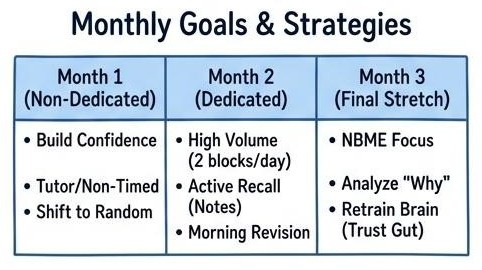
Month 1: The Foundation
My exam was scheduled for July, so I started in April. At the time, I was a 3rd-year radiology resident on a super hectic rotation. I could barely manage 4-5 hours of study a day.
Intent: Build confidence and get into a study flow without burning out.
- 1.
Start with Confidence Building: I intentionally started with the systems I was most comfortable with, like GIT and the Female Reproductive System. Starting with your strengths prevents you from getting overwhelmed early on.
- 2.
UWorld Strategy: Tutor and Non-Timed Mode: In the beginning, I did UWorld in non-timed, tutor mode. I wasn't rushing. I gave myself space to understand the question patterns. This phase is about learning, not testing.
- 3.
The Shift to Random: By mid-to-late April, once I had my rhythm, I gradually shifted to doing random blocks in timed tutor mode. This helps transition your brain from "learning specific topics" to "handling exam randomness."
- 4.
Avoiding Overwhelm: I knew I couldn't afford to burn out while working full-time. I stuck to what worked and made sure I understood the explanations thoroughly rather than chasing high question counts.
Month 2: Intensity & Depth
Moving into May, I had a lighter work schedule. I aimed for 8 to 9 hours of studying a day. However, let me be real with you: consistency means not letting one bad day turn into a bad week. Some days I just binge-watched TV, and that is okay.
Intent: High-volume practice and active recall through note creation.
- 1.
Two Blocks Per Day: I aimed for two blocks daily. Block 1 was always Random and Timed. Block 2 was flexible, either Topic-wise or in Tutor mode.
- 2.
The "No Check-Box" Rule: I never did a block just to tick it off my to-do list. I spent significant time reviewing thoroughly, especially the options I had trouble eliminating.
- 3.
Morning Revision Sessions: Before work, I squeezed in 2 hours to review notes or charts, capitalizing on my fresh morning brain.
- 4.
Dr. High Yield Videos: Around mid-May, I introduced these gems. Watched at 2x speed during commutes, they were perfect for passive revision.
Month 3: Final Stretch
This was June/July. The goal here was refining my test-taking strategy and trusting my gut.
Intent: Simulate exam conditions and stop over-analyzing.
- 1.
The NBME Focus: I focused heavily on NBMEs, doing about 5 forms spaced 5-6 days apart, treating them like the real exam.
- 2.
Analyzing the "Why": Between NBMEs, I reviewed the previous form extensively. It is mentally exhausting, but absolutely worth it.
- 3.
Retraining the Brain: UWorld trains you to overthink. NBMEs are more straightforward. I had to learn to stop second-guessing myself. If an answer looked simple, it usually was right.
The DNF Notebook System
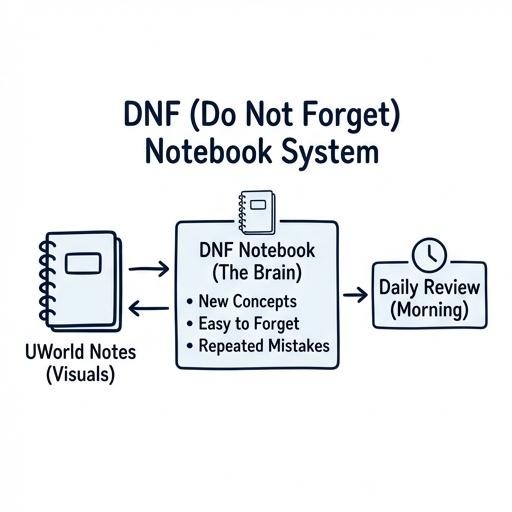
This was a game-changer for me. DNF stands for "Do Not Forget." I maintained two specific notebooks on my iPad and physical notes.
1. The UWorld Notebook (The Visuals)
This was for efficiency. I would copy and paste important tables, flowcharts, and images from UWorld, especially from visual-heavy topics like Dermatology. It is faster to paste them than to rewrite them.
2. The DNF Notebook (The Brain)
This is where the high-yield magic happened. I only wrote down three specific things here: Concepts that were completely new to me, things I knew I would forget easily, and topics I kept messing up repeatedly.
3. The Rule of Conciseness
Keep it short. Not everything goes in the notes. Only write what needs a second or third look. I reviewed these notes every single morning.
Mastering Key Resources
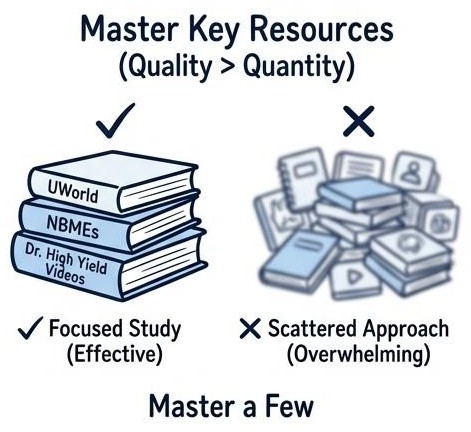
UWorld
Your primary textbook. Learn logic and patterns.
NBMEs
Your reality checks. Represent the actual exam style.
Dr. High Yield
Perfect for last-month revision of high-yield facts.
Amboss
Use very minimally, for specific look-ups only.
Things I'd Do Differently
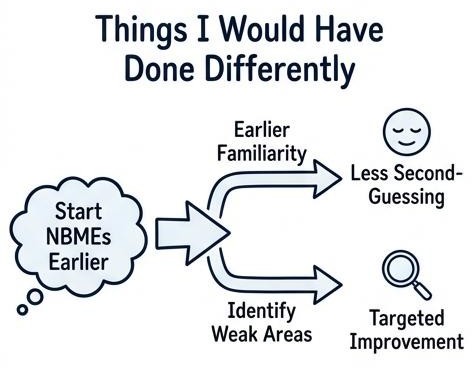
This roadmap worked for me because it was flexible enough to fit a full-time job but rigid enough to ensure I covered the necessary ground. Trust your preparation, stick to a few good resources, and don't let a bad day derail your week. Good luck!
This roadmap is the foundation version. It will keep evolving as I refine strategies, take in feedback, and add advanced insights. New versions go out through the newsletter.